
When planning a wedding for 100 guests, one of the most common questions couples ask is, How much should we budget for the cake?
The answer depends on what you're looking for.
A traditional wedding cake from a bakery might cost several hundred dollars to over $2,000, depending on its size, flavors, and decoration. A more elaborate custom cake may cost several thousand. At the luxury end of the market, where the cake becomes an individually commissioned work of art, the investment can be considerably higher.
At Connor's Craft Cakes, my commissions begin at $2,000. For context, if a couple commissioned a fully edible version of an architectural cake sculpture I created for a photoshoot at Monserate Winery, I would estimate an investment of approximately $6,000, depending on the final design and serving requirements.
Why such a significant difference?
Because the number of guests is only one small part of what determines the cost of a wedding cake.
Why I Don't Price Wedding Cakes by the Slice
Wedding cakes are traditionally priced by multiplying the number of servings by a fixed price per slice. It's a straightforward method, and for many bakeries, it makes perfect sense.
But that's not how I approach my work.
I see cake as a sculptural medium. The cake itself is the material through which I create something that tells a story, captures a feeling, and represents the people who commissioned it.
When a couple hires me, they're not simply purchasing 100 servings of dessert. They're commissioning an artist to interpret something deeply personal about their relationship and translate it into a physical object.
Imagine commissioning Michelangelo to create his sculpture of David and asking him to price it by the cubic foot of marble. Most of us would understand the absurdity of that question.
The marble is essential, of course. But its quantity doesn't explain the value of the sculpture.
The artistry, technical ability, vision, and years of experience that transform that material into something extraordinary are what matter.
I think about wedding cakes in much the same way.
What Actually Determines the Cost of a Custom Wedding Cake?
There are several factors that influence the price of my commissions, and many have very little to do with the amount of cake being served.
1. The Creative Process
Before I begin physically making a cake, I spend time getting to know the couple.
I'm interested in who they are together. Their personalities, their history, their shared experiences, the qualities they bring out in each other, and the atmosphere they want to create for their celebration.
During our consultation and tasting, I begin translating those conversations into a conceptual cake sculpture, often sketching ideas as we talk.
But the creative process doesn't necessarily end when the sketch is finished.
I keep the words, impressions, and ideas from our conversations in front of me as I work. They inform the choices I make about materials, proportions, movement, color, and composition.
Sometimes the piece doesn't fully come together until I'm physically assembling it.
That's part of working as an artist. I'm not simply following a predefined design. I'm interpreting a concept through the material itself.
The goal is to create something that feels as though it could only belong to that particular couple.
And that kind of creative development requires considerable time, attention, and artistic judgment.
2. The Scale, Shape, and Engineering
A wedding cake's size matters, but its dimensions and structure can matter even more.
A relatively simple five-tier cake may be less technically demanding than a smaller sculpture with unusual proportions.
Is the cake being carved into an unconventional shape? Are certain elements cantilevered or extending beyond the main structure? Does the design require an internal support system that allows it to maintain its shape securely until it's served?
Cake is an unusual sculptural medium because it's both edible and structurally vulnerable.
Achieving certain forms requires an understanding of engineering, weight distribution, material behavior, and the limitations of the ingredients themselves.
Sometimes what appears effortless in the finished sculpture is the result of years of experimentation and technical practice.
3. Artistic Technique and Detail
There's also the question of craftsmanship.
For example, I create realistic sugar flowers by hand. Making a flower that convincingly captures the character of its living counterpart requires far more than simply knowing how to shape petals.
It requires studying its structure, proportions, movement, color variation, and subtle imperfections.
Other designs may involve highly controlled architectural edges, delicate wafer-paper elements, intricate surface treatments, or sculptural forms that require specialized techniques.
These are skills developed over years, not hours.
And while the finished work should appear cohesive and natural, achieving that result can be extraordinarily labor-intensive.
4. Custom Flavor Development
Flavor is another important part of my process.
Rather than simply asking a couple to choose between chocolate, vanilla, or lemon, I enjoy exploring their personal food memories and experiences.
Perhaps there's a dessert they shared on an early date, a flavor associated with childhood, or an ingredient that reminds them of a meaningful place.
I use those references as a starting point to develop a cohesive flavor experience.
That can involve recipe development, ingredient sourcing, testing, refinement, and a substantial amount of culinary problem-solving.
The goal isn't to combine a collection of meaningful ingredients simply because they have sentimental value. It's to create something genuinely delicious that also connects to the couple's story.
This research and development is part of the commission, just as much as the visual design.
5. The Labor You Never See
One of the most overlooked factors in wedding cake pricing is the enormous amount of work that happens between the visible stages of production.
There's shopping, preparation, administration, organization, cleaning, and resetting the workspace.
For example, I might spend several hours carefully dusting handmade sugar flowers with petal colors. By the time I'm finished, the work surface and surrounding tools may be covered in fine pigment.
Before moving on to the next stage of the cake, everything needs to be cleaned, organized, and put away. Then an entirely different collection of tools and materials must be brought out and prepared.
That transition alone can take considerable time.
Multiply those transitions across the many stages of a complex commission, and the hours add up quickly.
The actual time spent physically decorating a cake is only one portion of the labor involved in creating it.
A $6,000 Wedding Cake Sculpture: The Monserate Design
One example of how artistic complexity influences pricing is a cake sculpture I created for an editorial wedding shoot at Monserate Winery in Southern California.
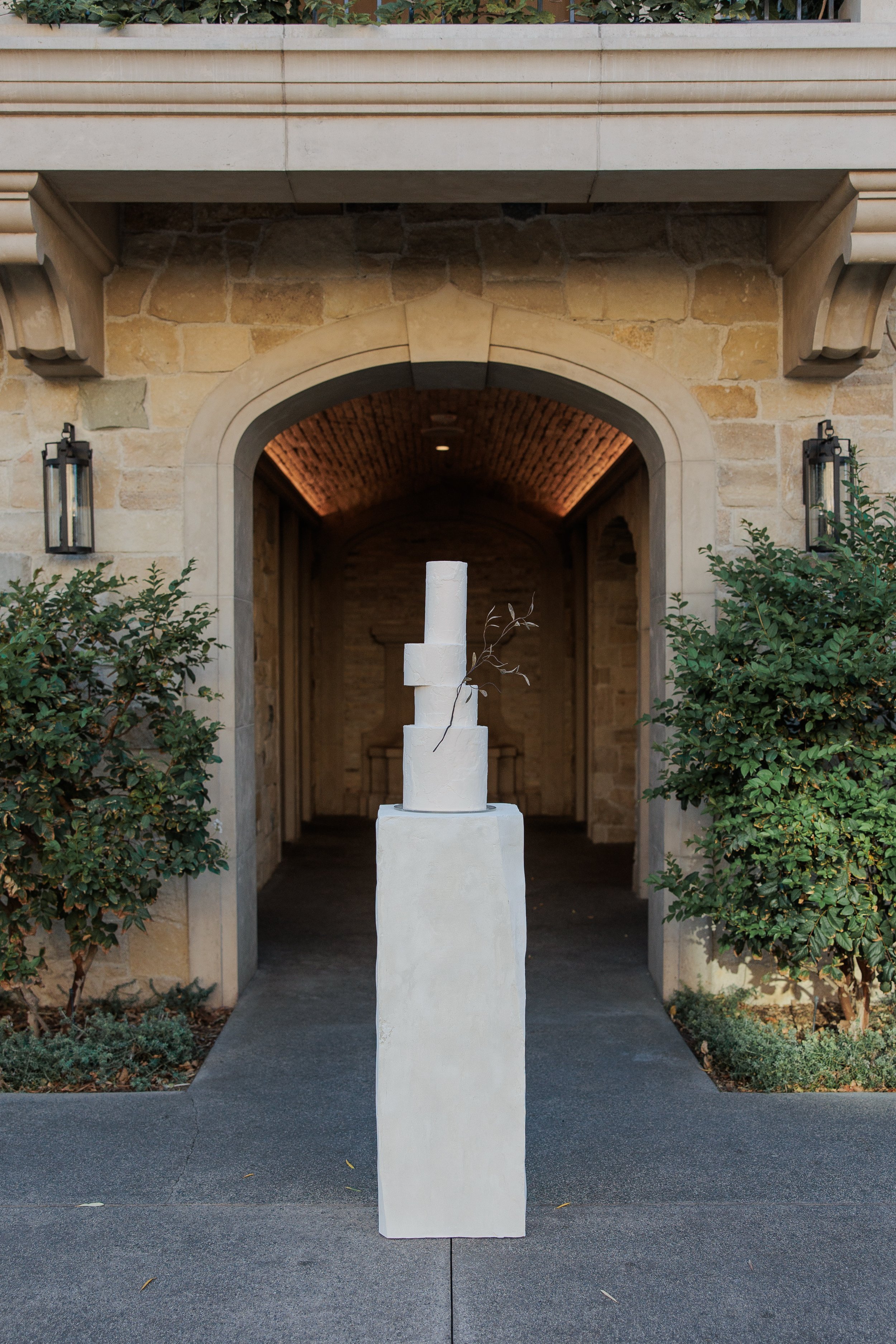
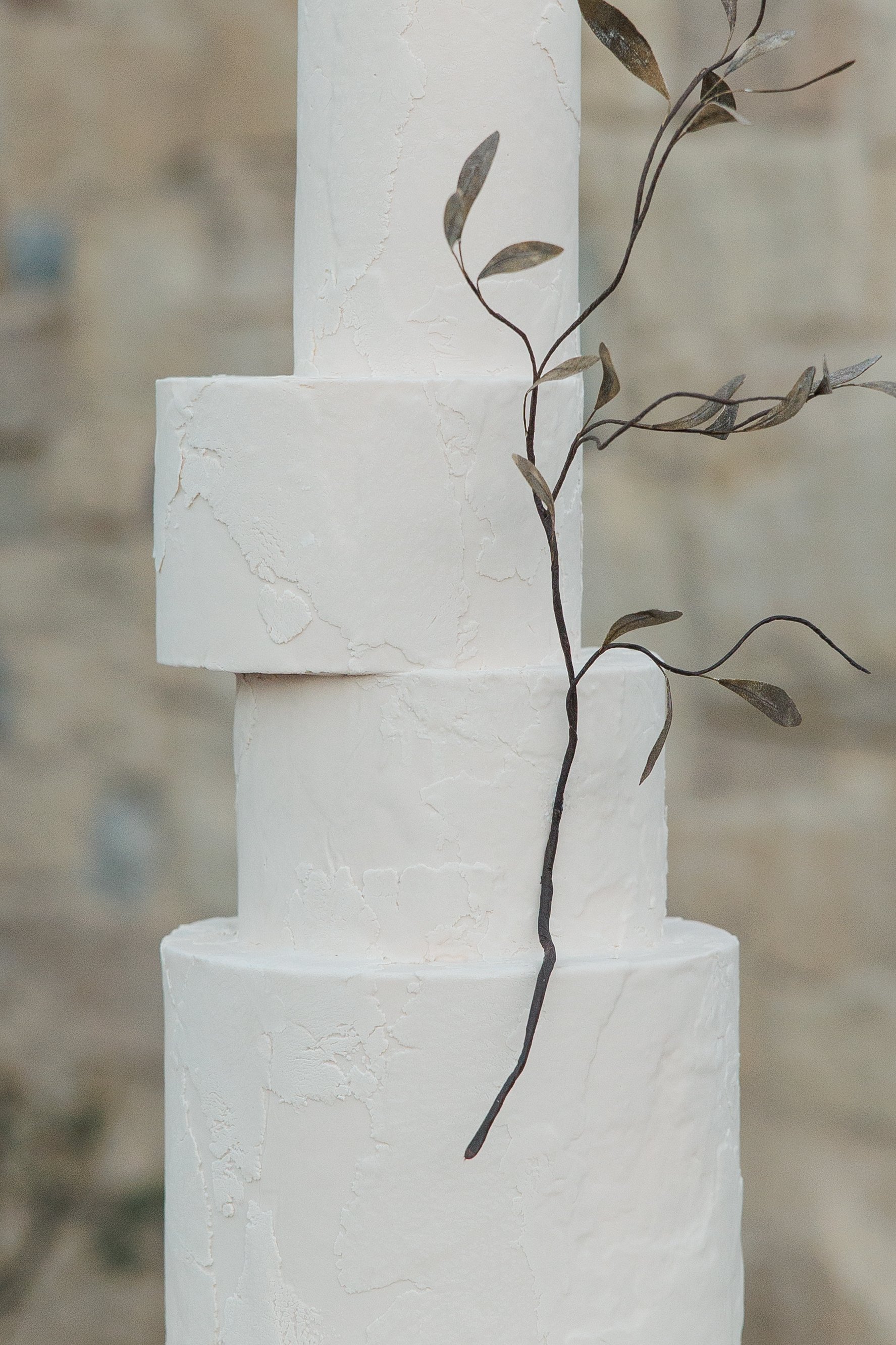
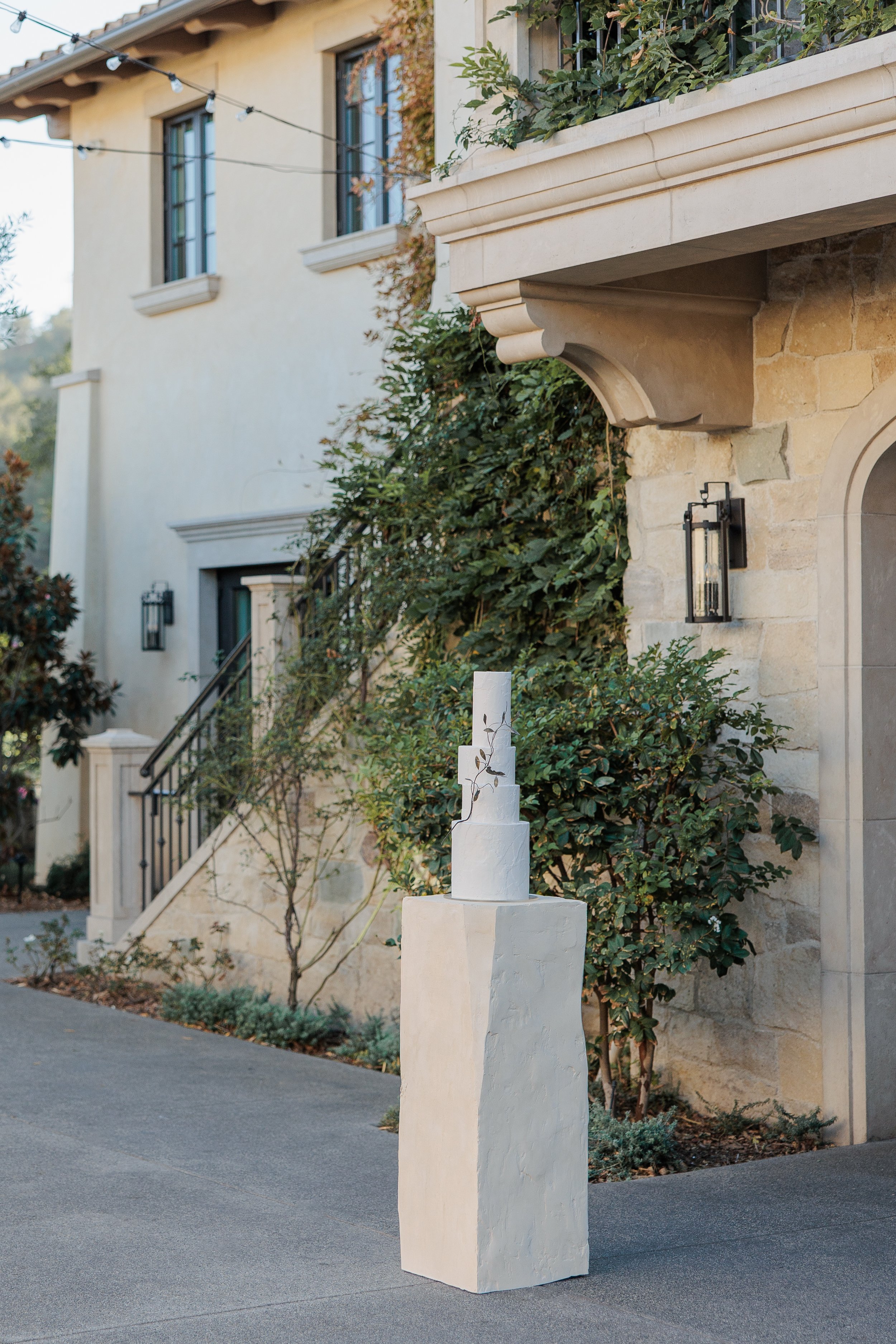
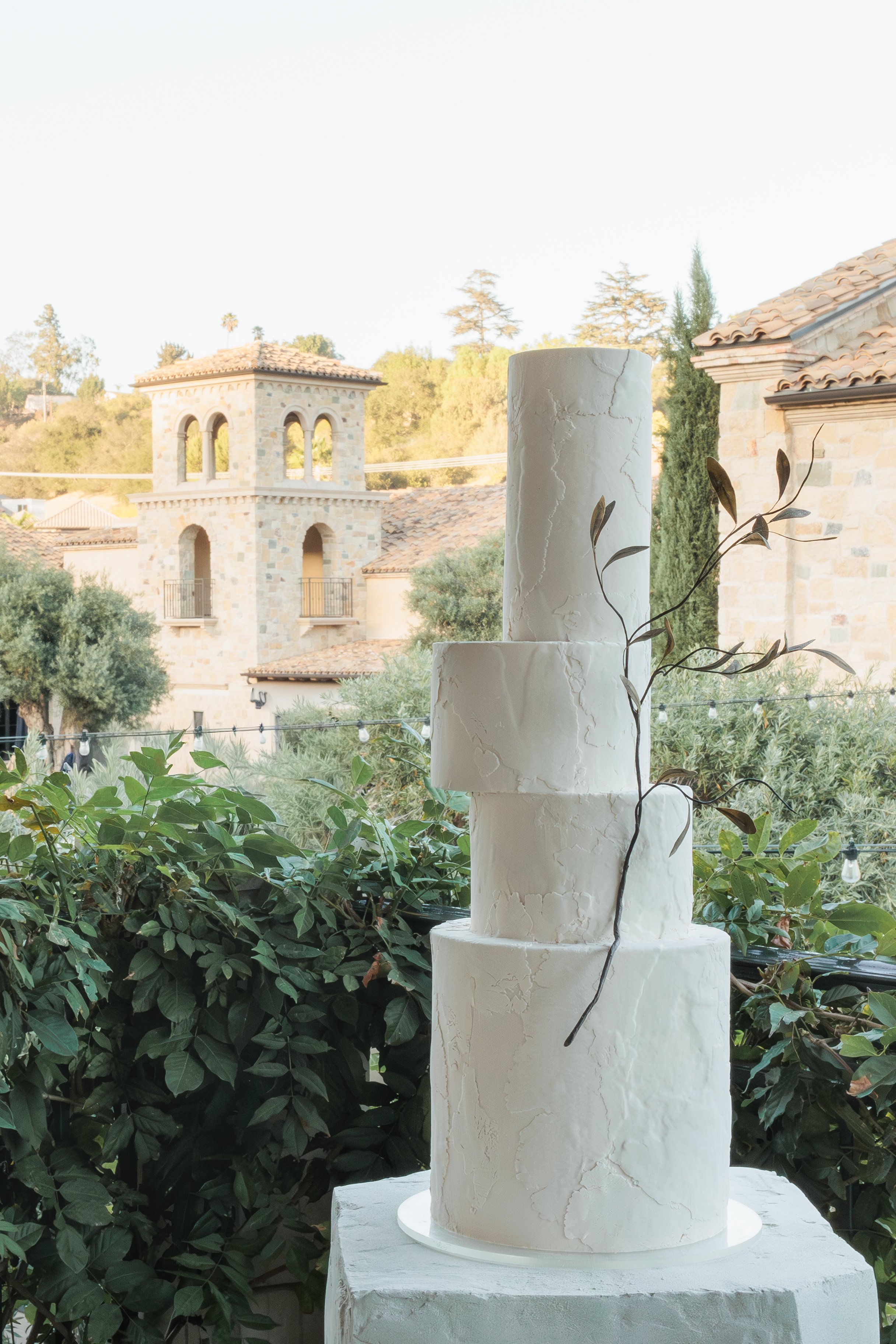
Photos captured by Aubrey Rae Jones
Valued at approximately $6,000 as a wedding commission, this piece demonstrates why the number of servings alone is rarely an accurate reflection of a cake's cost.
Rather than a traditional arrangement of stacked tiers, I explored an architectural composition of intersecting columns, varied proportions, historical Tuscan texture, and carefully considered negative space.
The relationship between these forms was essential to the design. Their positioning, height, texture, and balance all contributed to the overall composition. An organic handmade olive branch, crafted from wafer paper, introduced a contrasting sense of movement, softening the geometry without competing with it.
What makes a piece like this demanding isn't necessarily the quantity of cake involved. It's the artistic and technical expertise required to achieve the intended result, while ensuring the piece retains the feeling and character that inspired its design.
Maintaining sharp architectural edges, creating convincing material textures, and engineering an unconventional arrangement require approaches that differ significantly from traditional cake decorating.
The $6,000 valuation reflects more than the finished sculpture. It encompasses the experience of commissioning an artist—the conversations, creative interpretation, and personal connection that shape the work—as well as the technical planning, specialized craftsmanship, production, and delivery required to bring a design of this complexity to life.
A sculpture like this could contain fewer servings than a conventional five-tier wedding cake yet require considerably more artistic development and technical execution.
The number of servings tells you how much dessert you're purchasing. It doesn't necessarily tell you what it takes to create the artwork.
That's why I don't believe wedding cake artistry can be meaningfully valued by a fixed price per slice.
Does Your Wedding Cake Need to Serve All 100 Guests?
Not necessarily.
One of the most useful things couples can understand is that the size of the displayed wedding cake doesn't always need to correspond to the total guest count.
If the artistic concept calls for a smaller, more intimate sculpture, enlarging it simply to provide additional servings may compromise its proportions or overall composition.
Instead, additional cake can be prepared separately for the venue's kitchen to portion and serve.
This allows the displayed cake to maintain the intended artistic vision while still ensuring every guest receives dessert.
The priority becomes creating the right sculpture for the celebration, rather than allowing the number of servings to dictate its appearance.
How Can You Reduce Your Wedding Cake Budget Without Sacrificing the Design?
If a couple loves my work but has a firm budget, one of the first things I consider is whether we can reduce the scale of the sculpture.
I'd much rather create a smaller piece that fully expresses the concept than a larger one that compromises the design.
Scaling down can reduce certain material, production, and structural requirements while preserving the artistic integrity of the work.
Not every design scales down equally, of course. Some elements require particular proportions or dimensions to achieve the intended effect.
But it can be an effective way to bring the investment down without fundamentally changing what makes the piece special.
I believe the design should determine the scale, rather than the guest count alone.
Why Are Luxury Wedding Cakes So Expensive?
I think wedding cake artistry is often undervalued, even within the wedding industry.
Part of that comes from how we're accustomed to thinking about cake.
Most people have purchased a birthday cake from a bakery. It's natural to use that experience as a reference point when imagining what a wedding cake should cost.
But there's a significant difference between ordering a decorated cake and commissioning an artist to create a sculpture that represents your relationship.
In the latter, you're paying for years of technical experience, culinary knowledge, creative development, craftsmanship, and the ability to transform an abstract idea into something physical.
It's a highly specialized service.
What's interesting is that couples regularly allocate thousands, or even tens of thousands, of dollars toward florals, catering, entertainment, and other visual elements of their wedding.
Yet the cake, despite its symbolic significance, is often given a comparatively small portion of the budget.
I've seen wedding cake budgets represent only a small percentage of the overall celebration, sometimes around 1–3%.
And still, cake can be one of the expenses that receives the most resistance when couples discover what a truly custom piece costs.
I don't think every couple needs an elaborate sculptural cake. There's absolutely a place for beautiful, straightforward bakery cakes.
But I do think couples should understand what's possible before deciding how much the cake is worth to them.
For some, a delicious dessert is exactly what they want.
For others, the opportunity to commission an artist to interpret their story may be one of the most meaningful creative investments they make for their wedding.
Neither approach is wrong. They simply offer very different experiences.
Your Wedding Cake Deserves More Than a Corner of the Reception
Cake has an extraordinary place in our culture.
Think about a birthday celebration. The moment the cake comes out is often the moment everyone gathers, sings, claps, and celebrates the person at the center of the occasion.
The cake becomes a symbol of that collective joy.
Weddings are no different.
I love the idea of taking that already meaningful tradition and creating something that physically embodies the people being celebrated.
Imagine a couple standing beside their cake, explaining to their guests why a particular flower, curve, color, or sculptural movement was included.
Perhaps one element reflects a quality they admire in each other. Another references a shared memory or the atmosphere they wanted their wedding to evoke.
Suddenly, the cake is no longer just a beautiful object.
It's a conversation piece.
It's an invitation for guests to understand something about the couple they may not have known before.
And it's an artwork that belongs to that celebration in a way that a generic design never could.
That's why I believe a thoughtfully commissioned wedding cake deserves to be displayed prominently, somewhere guests can approach it, walk around it, and appreciate it as part of the visual experience of the reception.
It shouldn't simply disappear into a corner until it's time to be cut.
So, How Much Should You Budget for a Wedding Cake for 100 Guests?
The answer ultimately depends on the experience you're looking for.
If your priority is serving a delicious dessert to 100 people, a traditional bakery may be the most appropriate choice, and your budget can reflect that.
If you're looking for a completely custom artistic experience, one that includes personal storytelling, original design, technical craftsmanship, and curated flavor development, you should expect a considerably greater investment.
At Connor's Craft Cakes, commissions begin at $2,000. A complex architectural cake sculpture comparable to my Monserate design could represent an investment of approximately $6,000 for a 100-guest celebration, depending on its size, construction, and culinary requirements.
My advice is to think beyond the number of servings.
Ask yourself what role you want the cake to play in your celebration.
Is it simply dessert? Is it a decorative element? Or could it become an artwork that captures something meaningful about your relationship and creates a moment of connection between you and your guests?
For many couples, their wedding may be the only occasion in their lives when they commission an artist to create something entirely their own.
I think that's an extraordinary opportunity.
And if you choose to approach your wedding cake that way, its value becomes about much more than what it costs per slice.
Connor Mansberger is the cake artist behind Connor's Craft Cakes, a San Diego-based studio specializing in bespoke wedding cake sculptures. His work brings together sculptural design, technical craftsmanship, and personalized flavor development to create cakes that reflect the people and celebrations they belong to.